
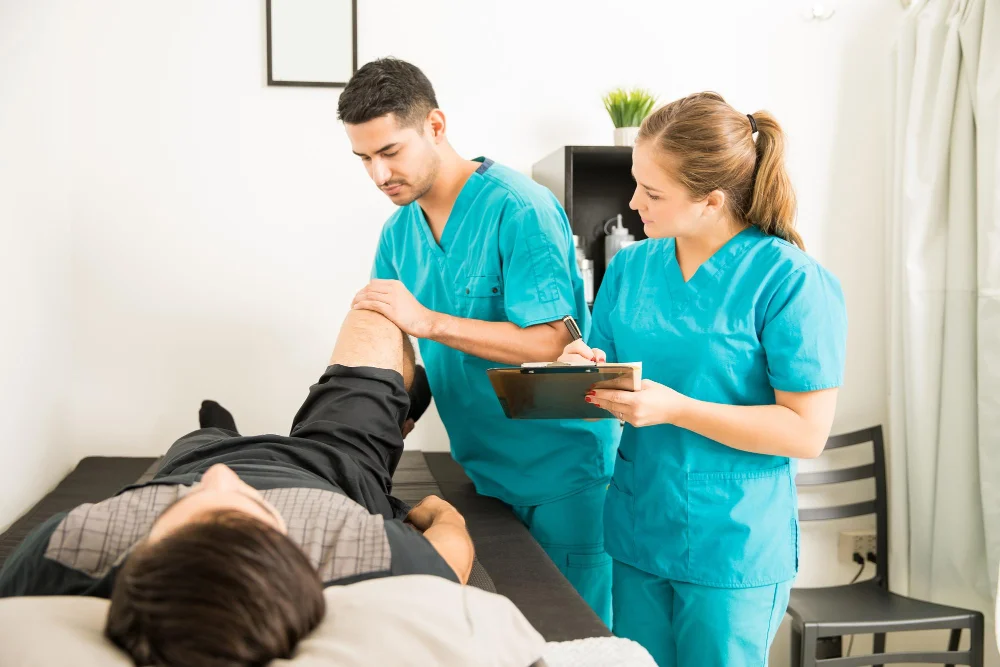
Can a Chiropractor Help a Sprained Knee?
Yes, a chiropractor can help a sprained knee when the injury is appropriate for conservative care. However, not every knee sprain requires the same approach. The injured ligament, severity of damage, knee stability, and ability to move normally all influence treatment. Some sprains respond well to progressive care, while significant instability or complete ligament damage requires greater caution. Understanding these differences is essential before choosing exercises, returning to activity, or deciding whether chiropractic care is appropriate.
What Is a Sprained Knee?
A sprained knee occurs when one or more of the ligaments supporting the knee are stretched beyond their normal range or torn. These strong bands of connective tissue help keep the knee stable while walking, changing direction, bending, and bearing weight. The injury can range from a minor ligament stretch to a complete tear, depending on the force placed on the knee. The injured ligament and damage severity can affect symptoms, stability, and treatment for a knee sprain.
Types of Knee Sprains
Knee sprains are named according to the ligament that has been injured. Four major ligaments provide much of the knee’s stability, and each can be sprained through different forces or movements. Understanding which ligament is affected helps explain where the pain occurs and how the knee may respond during movement.
The four main types of knee sprains are:
- MCL c Sprain:
The medial collateral ligament, or MCL, runs along the inner side of the knee. It helps prevent excessive inward movement of the knee and provides stability during side to side forces. An MCL sprain can cause pain and tenderness along the inner knee, especially after an impact or force pushes the knee inward. - LCL Sprain:
The lateral collateral ligament, or LCL, runs along the outer side of the knee. It helps protect the knee against forces that push it outward. An LCL sprain can produce pain and tenderness around the outside of the knee, particularly when the injured ligament is placed under stress. - ACL Sprain:
The anterior cruciate ligament, or ACL, sits inside the knee and helps control forward movement and rotation. It can be injured during sudden direction changes, awkward landings, or rapid stops. More significant ACL injuries can affect the knee’s stability during pivoting and other demanding movements. - PCL Sprain:
The posterior cruciate ligament, or PCL, is located inside the knee behind the ACL. It helps prevent the shinbone from moving excessively backward relative to the thighbone. A PCL sprain can occur after a direct impact to the front of the knee or another force that drives the shin backward.
A knee sprain can affect one ligament or several ligaments during the same injury. The specific ligament involved therefore matters when assessing the knee and deciding whether knee sprain chiropractic care is appropriate. A treatment approach that suits one ligament injury should not automatically be assumed to suit another.
What Is the Difference Between a Knee Sprain and a Knee Tear?
A knee sprain can involve different degrees of ligament damage, which is why the term does not describe one specific level of injury. The ligament may be overstretched, partially damaged, or completely disrupted. A knee tear refers specifically to damage within the ligament itself, so a tear can occur as part of a more severe knee sprain.
| Knee Sprain | Knee Tear |
|---|---|
| Refers to an injury involving a knee ligament. | Refers to damage within the ligament fibers. |
| Can range from mild stretching to significant ligament damage. | Can involve partial or complete damage to the ligament. |
| The effect on knee stability depends on the severity and affected ligament. | Greater tissue damage can reduce the ligament’s ability to stabilize the knee. |
The key point is that sprain and tear are not necessarily two separate injuries. The word sprain describes the ligament injury, while tear describes the structural damage that has occurred within that ligament. This distinction becomes useful when determining the appropriate care. The affected ligament, degree of damage, knee stability, and ability to move normally should all be considered before treatment is selected.
How Is a Knee Sprain Diagnosed?
A knee sprain is diagnosed by combining the injury history with a physical examination of the knee. For someone asking can a chiropractor help a sprained knee, an accurate diagnosis is the first step in determining whether chiropractic care is appropriate. The evaluation starts with questions about the injury. The clinician asks what happened immediately before the pain began, such as a sudden twist, awkward landing, collision, or force applied to the knee.
The timing of swelling and changes in movement can also provide useful information. During the physical examination, the clinician checks the knee for tenderness, swelling, and restricted movement. The knee is gently moved through its available range to identify painful or limited movements. The clinician also assesses knee stability during controlled movements. Specific ligament stress tests may then be performed when appropriate. These tests apply controlled force to the knee while the clinician observes movement and the patient’s response.
Excessive movement, pain, or a noticeable difference compared with the opposite knee can indicate ligament injury. Imaging may be considered when the examination does not provide enough information or when another injury needs to be ruled out. An X ray can identify bone abnormalities, while an MRI provides a clearer view of ligaments and other soft tissues. The diagnosis is based on the injury history, physical examination, and imaging when necessary. This helps identify the affected ligament and determine the extent of the knee injury.
Can a Chiropractor Help a Sprained Knee?
Yes. A chiropractor can help manage an appropriate knee sprain by addressing restricted movement, muscle dysfunction, joint mechanics, and the gradual restoration of normal knee function. The approach depends on which ligament is injured, the severity of the sprain, knee stability, and whether other structures were damaged. A chiropractor for sprained knee injuries can focus on restoring comfortable movement, improving joint function, and rebuilding the strength needed to support the healing ligament.
Care should protect the healing tissue while gradually restoring the movement, strength, coordination, and stability needed for normal activity. Stable Grade 1 and some Grade 2 sprains are commonly managed without surgery through progressive rehabilitation. More serious injuries, particularly complete ligament tears, significant instability, or injuries involving multiple structures, require appropriate medical evaluation before chiropractic treatment is considered.
Which Types of Knee Sprains Can Chiropractic Care Help?
Chiropractic care is most appropriate for knee sprains where the ligament injury has been properly assessed and the knee remains sufficiently stable for conservative rehabilitation. This commonly includes uncomplicated Grade 1 sprains and selected Grade 2 injuries.
MCL and LCL sprains can respond well to progressive rehabilitation focused on restoring knee movement, muscle strength, and control. These ligaments provide side to side stability, so rehabilitation needs to restore the muscles and movement patterns that support that function.
ACL and PCL injuries require greater caution. A mild ligament sprain can sometimes be managed conservatively, but significant ACL or PCL damage can produce instability and involve additional knee structures. These cases should be evaluated carefully before beginning a chiropractic rehabilitation program.
A Grade 3 sprain involves a complete ligament tear and should not be treated as a routine sprain. Persistent instability, inability to bear weight, rapid swelling, locking, or suspected injury to multiple knee structures warrants further medical assessment.
How Can Chiropractic Care Help a Sprained Knee?
A knee sprain chiropractic approach should focus on restoring function rather than attempting to manipulate the injured ligament itself. The rehabilitation process can address the loss of movement, muscle guarding, weakness, altered walking mechanics, and reduced control that often follow a knee injury.
The chiropractic treatment plan should progress according to the knee’s response. Early care can focus on comfortable movement and reducing unnecessary stress on the injured area. Later stages can introduce strengthening, balance work, controlled loading, and movements that resemble normal daily or sporting activities. This makes chiropractor sprain knee treatment different from simply treating knee pain. The objective is to restore the functions that were affected by the injury while allowing the ligament time to heal.
Assessment of Knee Movement and Stability
The first step is determining how the knee is functioning after the sprain. The assessment can include knee range of motion, tenderness, swelling, gait, muscle strength, and stability during controlled movements. The clinician also considers how the injury occurred and which movements reproduce symptoms.
Differences between the injured and unaffected knee can provide useful information about movement restrictions and functional weakness. This assessment helps determine which activities are appropriate and which movements should temporarily be limited. It also helps identify situations where further medical evaluation or imaging is more appropriate than chiropractic treatment.
Manual Therapy for Restricted Knee Movement
A sprained knee can become stiff because pain, swelling, and protective muscle guarding change how the joint moves. Manual therapy can be used to address restrictions in the knee and surrounding joints when the examination indicates that it is appropriate. Treatment should be gentle and directed toward restoring comfortable movement.
It should not involve aggressive manipulation of an unstable or acutely injured ligament. Manual therapy is therefore an adjunct to rehabilitation rather than a method of repairing damaged ligament fibers. The larger objective is to restore movement so the knee can tolerate progressive exercise and normal daily activity.
Soft Tissue Treatment for Surrounding Muscles
The muscles around the knee can become tense or inhibited after a sprain. Changes in walking and reduced use of the injured leg can also alter how the quadriceps, hamstrings, calf, and hip muscles work. Soft tissue treatment can address areas of muscle tension that restrict comfortable movement.
It can also make certain exercises and movement patterns easier to perform. The treatment is directed at the surrounding soft tissues rather than the damaged ligament itself. Restoring normal muscle function becomes particularly important when weakness or protective guarding is affecting knee movement.
Rehabilitation Exercises Based on the Injured Ligament
Exercise is a central part of recovering from a knee sprain. The exercises should match the injured ligament, the severity of the injury, current knee stability, and the person’s functional demands. Early rehabilitation can focus on restoring comfortable range of motion and activating the muscles that support the knee.
As movement improves, strengthening can progress to the quadriceps, hamstrings, calf, and hip muscles. Later exercises can introduce balance, single leg control, controlled squatting, stepping, and other movements that challenge knee stability. Neuromuscular training is particularly relevant after ligament injuries because knee injuries can affect strength and movement control.
The progression should be based on how the knee responds rather than adding exercises simply because a certain number of weeks have passed. A rehabilitation program should increase the demands placed on the knee as strength, movement, and stability improve.
Progressive Return to Normal Knee Movement
Returning to normal movement is more than simply waiting for knee pain to disappear. The knee should gradually regain the ability to tolerate the movements required for walking, stairs, squatting, changing direction, and other normal activities. Progression can begin with comfortable weight bearing and basic movement. It can then advance toward stronger loading, balance challenges, controlled directional changes, and activity specific movements when appropriate.
The final stage should reflect the demands placed on the knee. Someone returning to recreational walking has different requirements from someone returning to running, cutting, or competitive sport. A progressive approach reduces the risk of placing excessive stress on a healing ligament while the knee is still regaining strength and control.
Rehabilitation literature supports progressive range of motion, strengthening, neuromuscular control, and functional activity as important components of conservative ligament injury management.
Exercises and Activities During Knee Sprain Recovery
Exercises can help restore knee movement and strength as a sprained knee recovers. The exercises should match the stage of recovery and should not cause increasing pain, swelling, or a feeling that the knee is giving way. The following movements are commonly used as knee function improves.
Heel Slides
Heel slides help restore comfortable knee bending when stiffness makes it difficult to fully flex the knee.
How to do heel slides:
- Lie on the back with both legs straight.
- Slowly slide the heel of the injured leg toward the buttocks.
- Bend the knee only as far as comfortable.
- Pause briefly at the point of comfortable bending.
- Slowly slide the heel back until the leg is straight.
- Repeat the movement slowly without forcing the knee.
Quadriceps Sets
Quadriceps sets activate the muscles at the front of the thigh without requiring repeated knee movement. This can help maintain muscle activity when bending the knee is still uncomfortable.
How to do quadriceps sets:
- Lie on the back with the injured leg straight.
- Tighten the muscle at the front of the thigh.
- Gently press the back of the knee downward.
- Hold the contraction for several seconds.
- Relax the thigh completely.
- Repeat the contraction while keeping the leg still.
Straight Leg Raises
Straight leg raises strengthen the quadriceps while keeping the knee straight. They are useful once the injured leg can be lifted without significant pain or difficulty controlling the knee.
How to do straight leg raises:
- Lie on the back with both legs straight.
- Bend the unaffected knee and place that foot on the floor.
- Tighten the thigh muscle of the injured leg.
- Keep the injured knee straight and slowly raise the leg.
- Hold the leg briefly at the top.
- Lower it slowly back to the floor.
- Relax before repeating the movement.
Supported Mini Squats
Mini squats introduce controlled weight bearing and strengthen the muscles used when standing, sitting, and climbing stairs.
How to do supported mini squats:
- Stand behind a sturdy chair and hold it for balance.
- Place both feet about hip width apart.
- Slowly bend both knees and lower the body a short distance.
- Keep the knees aligned with the feet.
- Stop before the movement causes pain or instability.
- Push through the feet to return to standing.
- Keep the movement slow and controlled.
Single Leg Balance
Single leg balance challenges the muscles and joints that help control the knee while standing on one leg. It is more appropriate once comfortable weight bearing has returned.
How to do single leg balance:
- Stand beside a sturdy surface for support.
- Shift the body weight onto the injured leg.
- Lift the opposite foot slightly from the floor.
- Keep the standing knee slightly bent.
- Maintain the position while keeping the knee controlled and aligned with the foot.
- Use the support when needed to maintain balance.
- Place the opposite foot down before control is lost.
Activities to Limit During Knee Sprain Recovery
Running, jumping, pivoting, sudden changes of direction, and activities that place high stress on the knee should be limited while the ligament is healing. Normal walking and daily activities can be increased gradually when they can be performed without significant pain, swelling, or instability. The knee should be able to tolerate basic movements before progressing to more demanding activities. If an exercise causes increasing pain, swelling, or a feeling that the knee is giving way, the activity should be stopped and the injury reassessed.
Chiropractic Care for a Sprained Knee at Ashburn Village Chiropractic
A sprained knee needs more than pain relief. The injured ligament, knee stability, range of motion, and surrounding muscle function all need to be considered before deciding how the injury should be managed. At Ashburn Village Chiropractic, Dr. Jonathan Solomon evaluates these factors to determine whether chiropractic care is appropriate for the knee injury. Dr. Jonathan Solomon has provided chiropractic care in Ashburn since 2000.
He earned his Doctor of Chiropractic degree, cum laude, from Life Chiropractic College in Marietta, Georgia, in 1996. He is licensed by the Virginia Board of Medicine and nationally board certified, with more than two decades of experience caring for musculoskeletal conditions.
A knee chiropractor evaluates how the knee moves and functions after a sprain before determining the appropriate course of care. Dr. Solomon considers the mechanism of injury, knee movement, stability, surrounding muscle function, and other findings that can affect treatment. Ashburn Village Chiropractic also has an on site X ray machine when imaging is appropriate to evaluate certain injuries. Treatment is based on the condition of the knee rather than applying the same approach to every sprain.
When conservative chiropractic care is appropriate, treatment can focus on restoring comfortable movement, addressing surrounding soft tissue restrictions, and progressing exercises as knee function improves. More significant ligament injuries, substantial instability, or suspected damage to other knee structures require appropriate medical evaluation. Identifying these situations is an important part of responsible knee care.
With more than two decades of experience serving patients in Ashburn, Dr. Jonathan Solomon provides individualized evaluation and conservative care for appropriate knee injuries, including sprained knees.
Get a summary of this article with your favorite AI: