

No. Scoliosis is not caused by poor posture. True scoliosis involves structural spinal curvature with vertebral rotation, which cannot develop from slouching or temporary alignment changes. The question, Can Scoliosis Be Caused By Poor Posture, often arises because postural imbalance can mimic visible asymmetry. However, functional posture changes remain flexible and reversible, while structural scoliosis involves measurable anatomical deviation. Understanding this distinction is essential for accurate diagnosis and appropriate conservative management. Chiropractic care focuses on improving spinal mobility, restoring muscular balance, and correcting mechanical dysfunction that contributes to poor posture without altering structural curvature.
Can Scoliosis Be Caused By Poor Posture
No. Scoliosis is not caused by poor posture. True scoliosis involves structural spinal curvature with vertebral rotation. Postural habits alone do not create permanent rotational deformity of the vertebrae. Slouching may change how the spine appears temporarily, but it does not alter bone structure.
The question Can Scoliosis Be Caused By Poor Posture often arises because posture changes can mimic asymmetry. Rounded shoulders or uneven sitting positions may resemble curvature. However, structural scoliosis is defined by measurable spinal deviation on imaging. Postural imbalance is functional and typically reversible. Structural curvature involves anatomical changes within the spine.
Understanding this distinction prevents unnecessary concern. Not every visible asymmetry represents true scoliosis. Clinical evaluation determines whether curvature is structural or posture related.
Difference Between Postural Imbalance And True Spinal Curvature
Postural imbalance refers to muscular and positional deviation without permanent spinal change. It often develops from prolonged sitting, screen use, or uneven weight distribution. The spine remains flexible and correctable when posture improves. Imaging does not reveal fixed vertebral rotation in these cases.
True spinal curvature involves measurable lateral deviation with rotational change. The curve remains present even when posture is corrected. Structural scoliosis does not fully resolve with conscious repositioning. This distinction is essential for accurate diagnosis and appropriate management.
Why Vertebral Rotation Cannot Develop From Slouching Alone
Vertebral rotation results from structural adaptation within the spine. It develops due to growth related factors, congenital changes, or degenerative processes. Slouching affects muscular support but does not reshape vertebral bone. Temporary flexion posture does not generate rotational deformity.
Sustained poor posture may contribute to muscular imbalance and spinal stiffness. However, it does not create the three dimensional curvature pattern seen in scoliosis. Differentiating mechanical strain from structural deformity ensures proper clinical guidance.
What Causes Poor Posture
Poor posture develops from sustained mechanical stress rather than structural deformity. It reflects muscular imbalance and movement adaptation over time. Unlike scoliosis, postural deviation does not involve fixed vertebral rotation. Many individuals confuse these conditions when asking, Can Scoliosis Be Caused By Poor Posture. Understanding the true causes of postural change helps clarify this distinction.
Postural decline often begins gradually. Small alignment shifts become habitual through repetition. Without corrective awareness, compensatory patterns reinforce themselves. Over time, these adaptations influence joint loading and muscular endurance.
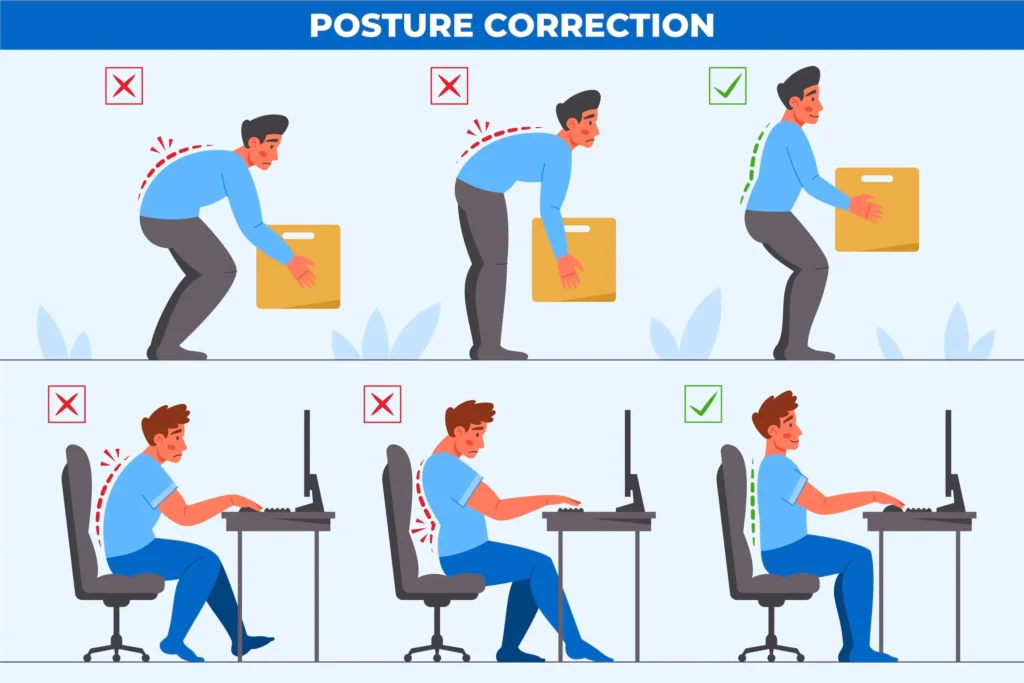
Prolonged Sitting And Screen Time
Extended sitting reduces activation of postural stabilizing muscles. Forward head positioning increases strain on the cervical and upper thoracic regions. Screen use encourages rounded shoulders and thoracic flexion. Sustained flexion shortens anterior chest musculature. Reduced extension mobility limits upright alignment tolerance.
Sedentary behavior also decreases core engagement. Without active stabilization, the spine relies on passive structures for support. This leads to fatigue and postural collapse by the end of the day.
Muscle Imbalance And Core Weakness
Posture depends on coordinated muscular support across the spine and pelvis. Weak deep stabilizers reduce segmental control. Overactive superficial muscles attempt to compensate for this weakness. The imbalance alters joint alignment under load.
Core weakness often presents as anterior pelvic tilt or rib flare. These patterns shift spinal curves away from neutral positioning. Balanced strength between anterior and posterior muscle groups is essential for postural endurance.
Pelvic Misalignment And Spinal Compensation
The pelvis forms the foundation of spinal alignment. Even minor asymmetry alters weight distribution through the lumbar spine. Compensatory curvature develops above the level of imbalance. This curvature is functional rather than structural.
Pelvic rotation or tilt often results from uneven loading habits. Crossing legs consistently or favoring one side during standing contributes to asymmetry. Correcting pelvic mechanics improves overall posture.
Repetitive Occupational Strain
Workplace demands significantly influence postural health. Repetitive forward reaching increases thoracic flexion dominance. Prolonged standing on one leg promotes lateral imbalance. Asymmetrical lifting reinforces compensatory spinal positioning.
Over time, repetitive strain reduces joint mobility and muscular efficiency. Addressing occupational patterns is critical for long term postural correction. Identifying environmental contributors supports sustainable improvement.
Can A Chiropractor Help With Poor Posture
Yes. A chiropractor can help improve poor posture when it results from joint restriction, muscular imbalance, or mechanical stress. Postural deviation is often functional and reversible. It develops from repetitive positioning rather than structural deformity. This distinction is important when evaluating whether Can Scoliosis Be Caused By Poor Posture, as structural curvature differs from correctable imbalance.
Chiropractic care focuses on identifying movement limitations that prevent neutral alignment. Treatment does not simply encourage standing straighter. It addresses the underlying mechanical factors that reduce postural endurance. When joint motion and muscular coordination improve, upright positioning becomes easier to maintain.
Identifying Mechanical Dysfunction Affecting Posture
Postural imbalance often reflects restricted joint segments or asymmetrical loading patterns. A clinical assessment evaluates spinal motion, pelvic positioning, and muscle activation. Subtle joint fixation may alter how weight is distributed through the spine. Over time, these restrictions contribute to visible asymmetry.
Functional evaluation includes observation during sitting, standing, and walking. Movement analysis reveals compensatory strategies that are not visible at rest. Identifying these dysfunctions guides targeted correction rather than generalized advice.
Restoring Spinal Mobility And Alignment
Reduced segmental motion limits the spine’s ability to maintain neutral positioning. Chiropractic adjustments aim to improve controlled joint mobility. Improved motion allows surrounding muscles to function more efficiently. This reduces reliance on compensatory tension.
Alignment improvement in postural cases reflects mechanical optimization rather than structural alteration. Restoring normal movement patterns supports symmetrical load distribution. Balanced mobility enhances postural comfort during prolonged activity.
Improving Neuromuscular Control And Stability
Posture depends on coordinated activation of stabilizing muscles. Delayed or weak engagement reduces spinal support. Neuromuscular retraining enhances awareness of spinal positioning. Improved control increases endurance during daily tasks.
Core stabilization plays a central role in maintaining alignment. Strengthening deep stabilizers reduces overactivity of superficial muscles. Efficient muscle recruitment improves balance between anterior and posterior support systems.
Long Term Postural Correction Through Conservative Care
Sustainable postural correction requires consistent management rather than temporary cues. Conservative care focuses on gradual adaptation of movement patterns. Repeated reinforcement of proper mechanics improves habitual alignment.
Education regarding workplace ergonomics and daily habits supports lasting results. Addressing environmental contributors reduces recurrence of imbalance. Structured care plans emphasize progression and monitoring to ensure measurable improvement over time.
Exercises To Correct Poor Posture
Corrective exercises support postural improvement when imbalance is functional rather than structural. These movements target mobility, stabilization, and muscular coordination. They are relevant because poor posture often results from muscle imbalance and reduced spinal control. While the question Can Scoliosis Be Caused By Poor Posture addresses structural curvature, posture itself can improve through guided rehabilitation.
Providing clear exercise instruction helps individuals take active responsibility for spinal health. Structured home care supports clinical treatment and encourages long term engagement. When patients understand how to perform movements correctly, outcomes improve and confidence increases. Education and guided exercise also strengthen trust in conservative management.
Perform each exercise slowly and with controlled breathing. Stop if discomfort increases.
Cat Camel For Spinal Mobility
Cat Camel Exercise improves controlled spinal flexion and extension.
- Step 1: Begin on your hands and knees with your spine neutral.
- Step 2: Position your hands under shoulders and knees under hips.
- Step 3: Slowly round your back upward while lowering your head.
- Step 4: Hold briefly at the top of the movement.
- Step 5: Gradually lower your abdomen and lift your head slightly.
- Step 6: Repeat for 10 controlled repetitions.
Bird Dog Exercise For Core Stability
Bird Dog exercise enhances coordinated spinal stabilization.
- Step 1: Start on hands and knees with a neutral spine.
- Step 2: Engage your abdominal muscles gently.
- Step 3: Extend one arm forward at shoulder height.
- Step 4: Extend the opposite leg backward at hip height.
- Step 5: Keep hips level and avoid rotation.
- Step 6: Hold for five seconds and switch sides.
- Step 7: Perform 8 to 10 repetitions per side.
Pelvic Tilt For Lumbar Alignment
Pelvic Tilt movement improves awareness of lower spinal positioning.
- Step 1: Lie on your back with knees bent and feet flat.
- Step 2: Place arms at your sides.
- Step 3: Gently tighten abdominal muscles.
- Step 4: Press your lower back into the floor.
- Step 5: Hold for five seconds while breathing normally.
- Step 6: Relax and repeat for 10 to 15 repetitions.
Hamstring Stretch For Posterior Chain Balance
Hamstring stretch reduces tension that influences pelvic positioning.
- Step 1: Sit with one leg extended forward.
- Step 2: Bend the opposite knee comfortably.
- Step 3: Keep your back straight.
- Step 4: Lean forward from the hips toward the extended leg.
- Step 5: Hold for 20 to 30 seconds.
- Step 6: Repeat on the opposite side.
Prayer Stretch For Thoracic Flexibility
Prayer Stretch movement promotes gentle spinal elongation.
- Step 1: Begin on hands and knees.
- Step 2: Sit hips back toward heels.
- Step 3: Extend arms forward along the floor.
- Step 4: Lower chest gently toward the ground.
- Step 5: Maintain steady breathing.
- Step 6: Hold for 20 to 30 seconds before returning upright.
Chiropractor For Poor Posture At Ashburn Village Chiropractic
Ashburn Village Chiropractic is located in Ashburn VA and has served the community for over 20 years. As the longest standing chiropractic office in the area, the practice focuses on personalized and non surgical care for musculoskeletal conditions. Dr. Jonathan Solomon earned his Doctor of Chiropractic degree cum laude from Life Chiropractic College in 1996 and holds a Bachelor of Arts from Rutgers College. He is licensed by the Virginia Board of Medicine and is nationally board certified in chiropractic care. Every patient receives a thorough examination, and when clinically appropriate, an on site X ray machine is used to better evaluate spinal alignment and structural findings. Ashburn Village Chiropractic also offers a free 15 minute consultation for individuals who have questions about posture concerns or treatment options.
Get a summary of this article with your favorite AI: